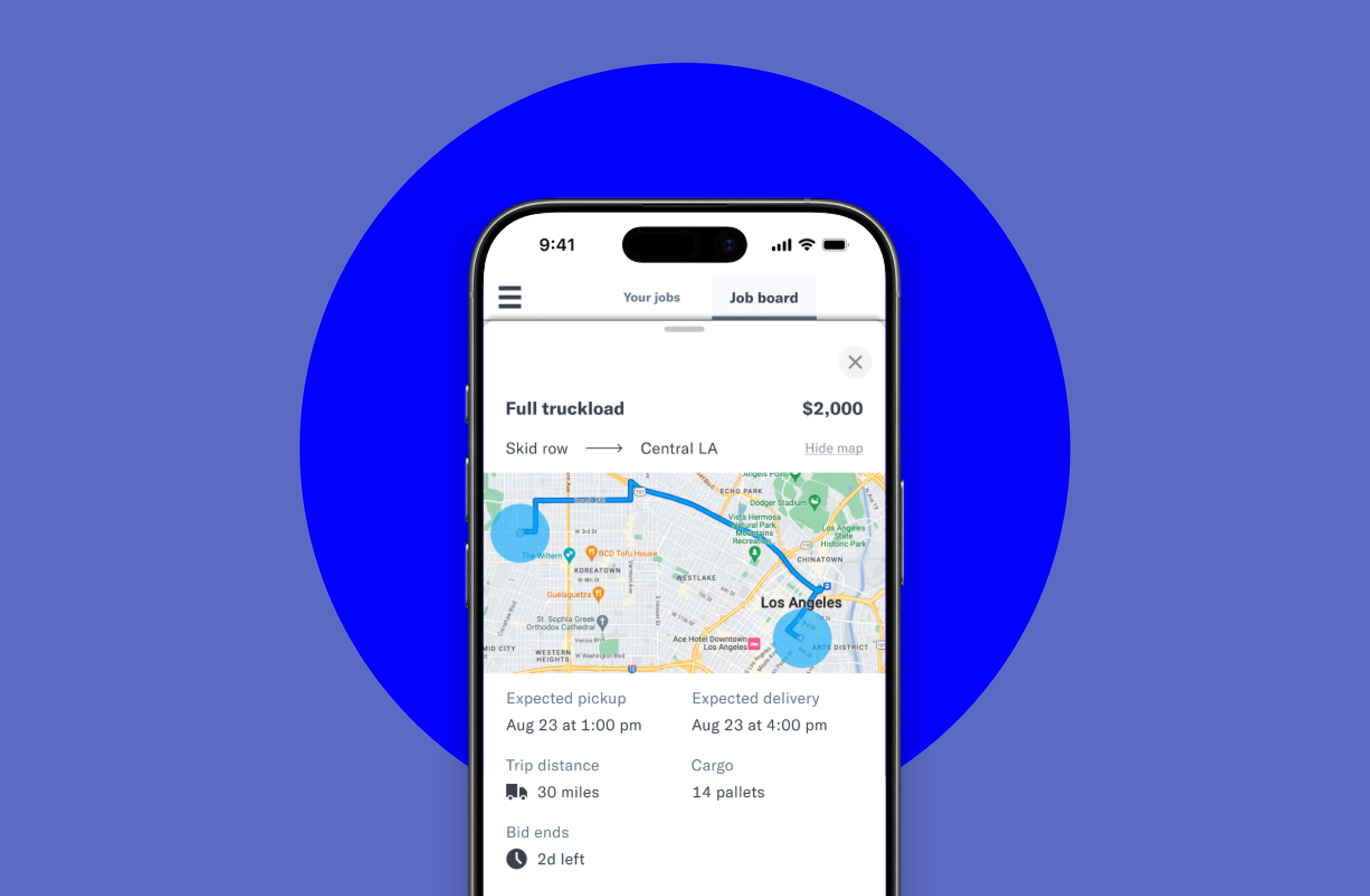
Owner-operators in the trucking industry had no centralized, transparent way to discover, bid on, or manage their freight workload; forcing them to rely on phone brokers and fragmented paperwork. I designed Ignition, a mobile-first app that brought the on-demand model to trucking: a live job board for browsing and bidding on loads; Alongside FlexScore, a real-time performance metric that creates a transparent feedback loop between carriers and Flexport, unlocking better loads and higher rates for high-performing drivers.
Problem
Independent truck drivers had no real-time visibility into available freight and no transparent way to price or
compete for loads. Load matching relied on phone brokers, fragmented boards, and opaque pricing; leaving drivers
either idle or undervalued, and Flexport unable to efficiently move freight through its carrier network.
Solution
A mobile job board that surfaces available loads with clear pricing, routes, and deadlines; alongside FlexScore,
a transparent performance metric that helps drivers understand, improve, and leverage their reliability to
unlock better opportunities.
Impact
Brought freight discovery from phone-based brokers to a self-serve mobile app
Reduced time-to-bid by removing the need for broker intermediaries
Created a transparent performance feedback loop between carriers and Flexport
Designed FlexScore to reward reliability with access to better loads and higher rates
The invisible freight market
Trucking is a nearly $900 billion industry in the US, yet for independent owner-operators, finding the next
load often meant waiting by the phone for a broker to call. The loads existed, visibility didn't.
Flexport had a growing network of available freight but no direct channel to independent carriers. Booking was
slow, expensive, and relationship-dependent on both ends. Drivers were underutilized. Loads were delayed. The
system worked through inertia, not design.
Freight booking relied on phone brokers and fragmented load boards with no price transparency
Who books the loads?
Research with independent owner-operators surfaced a consistent profile: drivers running small
operations, often 1 to 3 trucks, who made every booking decision themselves. They valued speed, price
transparency, and predictability over loyalty to any broker.
Key tensions emerged quickly: drivers needed to plan days ahead to optimize routes and income, but they also
had to move fast when a good load appeared. They were comfortable with mobile apps but deeply skeptical of
anything that felt like another middleman taking a cut or obscuring the terms.
Two questions drove the design: what information does a driver need to say yes or no to a load in under 30
seconds? And how do you build enough trust that they stop calling their broker first?
The job board
The job board is the core of Ignition. Loads are organized chronologically by pickup date, making it easy to
scan availability and plan ahead. Each load card surfaces the job type, origin-to-destination route, pickup
time, distance, price, and bid deadline. Everything a driver needs to make a decision without a phone call.
Two tabs serve two different mental modes: Your Jobs shows booked loads and the upcoming schedule, while Job
board is the discovery surface. Separating planning from browsing keeps the two contexts clean and prevents
the cognitive overload of mixing committed and available work.
Removing the first blocker
New drivers who hadn't completed their carrier profile saw a contextual banner prompting them to provide
required information before taking jobs. The blocker surfaced inline,
rather than behind a separate onboarding gate that most users would otherwise churn at, thus giving users the ability to observe
the value of the app by exploring the job board.
Job board with loads organized by date, showing job type, route, price, and bid deadline
Built for being in motion
Drivers aren't sitting at a desk when they use this app. The entire interaction model was designed around a
single constraint: every action needs to be completable with one thumb, in under five seconds, without pulling
over.
Load cards surface the three most decision-critical signals: price, pickup time, and distance, at a scale
readable in under three seconds. Secondary details collapse behind a tap, keeping the default view uncluttered
for quick reads between stops. No small text. No buried actions. No decision that requires scrolling to
resolve.
GPS-triggered check-ins
Rather than expecting drivers to remember to log milestones manually, the app uses GPS proximity to surface
the right action at the right moment. As a driver approaches a pickup location, a check-in prompt appears
automatically. The same logic fires at delivery. The driver confirms with a tap, the system handles the rest.
Logging happens because the app knows where the truck is, not because the driver remembered to open the app.
GPS-triggered check-in prompt and one-tap milestone logging designed for use on the road
Timers that work with the driver's schedule
Bid deadlines, pickup windows, and reporting requirements are all time-sensitive; but a notification at the
wrong moment is worse than no notification at all. Alerts are calibrated to arrive when a driver realistically
has time to act: a bid expiring in 30 minutes triggers a reminder during a window between stops, not while
they're backing into a dock. Timers also guard FlexScore: drivers are nudged to file exceptions before the
reporting window closes, protecting their score without requiring them to track deadlines themselves.
Milestone updates, arrival timestamps, and route confirmations are pre-populated from GPS data and presented
as one-tap approvals. The driver's job is to confirm what the app already knows, not to type, search, or
navigate to find the right form.
More than just a rating
FlexScore is a composite performance metric that measures what actually matters in freight: on-time delivery,
reporting accuracy, accessorial claims, and compliance. It's surfaced prominently in the navigation drawer so
drivers encounter it every time they open the app.
Unlike opaque broker reputation scores, FlexScore breaks down every contributing factor with its impact level
and historical trend. Drivers know exactly why their score is what it is, and exactly what to change to
improve it.
Incentive by design
Drivers with Excellent scores get access to more loads at higher rates, making FlexScore a growth lever. The score creates a direct, understandable connection between day-to-day driver
behavior and long-term earning potential. The design made that connection visible and actionable from day one.
FlexScore wireframing: breakdown and trend history
Transparency builds trust
Drilling into any score factor opens a detail view: the exact metric, a plain-language rating, the trend over
time, and a contextual explanation of what's being measured and why it matters.
The Recent Changes panel goes further, showing the delta and
the specific events that drove each change. A driver who was late on 5 shipment milestones sees exactly that,
along with actionable guidance on filing exceptions to protect their score.
This transparency was intentional. Drivers who understand the system trust it. Drivers who trust it perform
better. Better performance improves load coverage on the Flexport side. The feedback loop works because both
ends can see it.
Ignition was designed as a B2C mobile product within Flexport's carrier ecosystem. The FlexScore system was
intentionally built around structured, comparable performance data—creating a foundation that could eventually
power automated load matching, where Flexport proactively surfaces the right loads to the right drivers based
on score, route history, and proximity.
The path to automated matching
Because FlexScore externalizes carrier performance as structured data, it creates the inputs needed for
intelligent load matching. A driver's on-time delivery rate, reporting speed, route history, and current
score are all machine-readable signals that can be acted on without human intervention.
The next evolution of Ignition was an algorithm-assisted matching layer: rather than drivers scanning a
board for loads, the app would surface loads most likely to be a good fit, based on score, accepted routes,
and real-time proximity. The job board design was built to accommodate ranked and personalized results
without restructuring the core browsing flow.
Explore some of the many screens designed for the different flows of Ignition